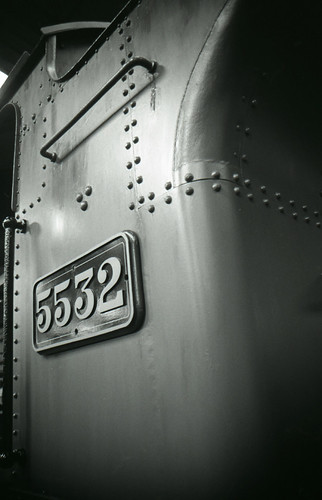
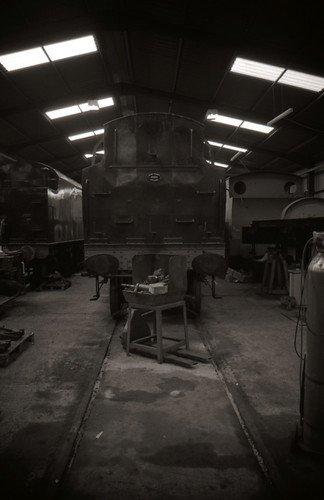
This assemblage of trackside stuff (sorry, I don't know the correct terminology) caught my eye on the way out of the workshops, and I thought it worthy of a photo.
I like the tones, and the shapes very much, and although the colours were nicely rusty, I think the B&W treatment via Ilford HP5+ suits it (good job too, as this is the only shot I took). This shot also marks a return to metered exposure, as it was taken after the shot of 6880's cab (below).
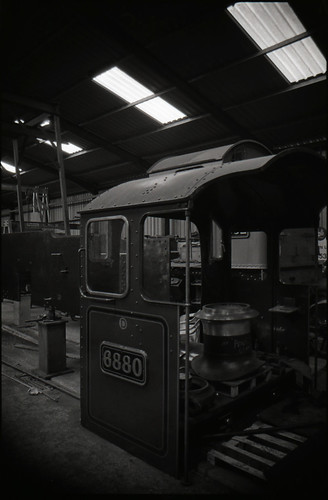
6880, originally uploaded by John the Monkey.
This shot shows the cab of 6880, Betton Grange. This is an unusual project, as so far as I understand, this loco never existed. None of the Great Western "Grange" class locomotives escaped the cutters torch. So the 6880 society is building this Grange class engine as a new build - you can find more information here. (Note that their website is undergoing some work, so not all linked content exists - their "About Us" page, which I've linked to here, does though).
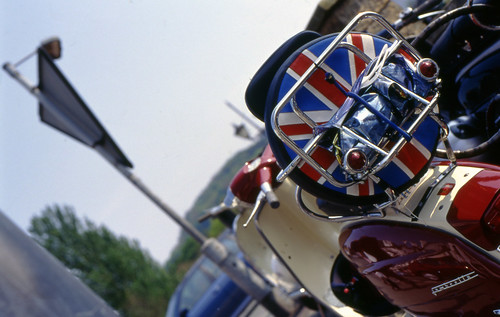
Pro Patria, originally uploaded by John the Monkey.
Sometimes, it's nice to be reminded of a simple thing's virtue - this was shot with the 50mm f/1.8 AF-N. Not bad for £60 worth of second hand lens.
Llangollen seems to be popular with riders of scooters and motorcycles alike, and this patriotically decorated Lambretta caught my eye.
Museum, originally uploaded by John the Monkey.
Lastly, here's something from along the canal towpath, another view of the Llangollen Motor Museum's fuel tank, advertising their presence to the traveller.
Saturday, June 9, 2007
Signs
Thursday, May 31, 2007
More Context
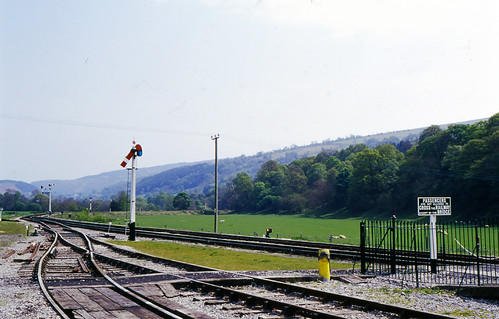
The shot above is taken from Carrog Station, looking down the track towards Berwyn, and beyond there Llangollen itself.
A little while after this was taken, Foxcote Manor arrived, and I comprehensively muffed the picture I was going to take of it, which irked me no end.
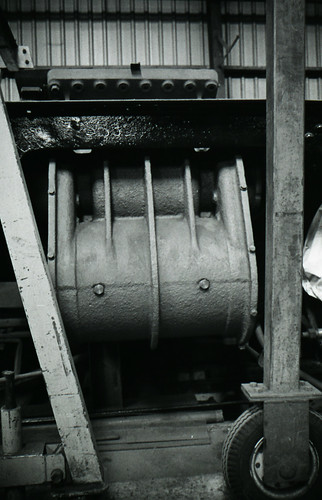
Cylinder, originally uploaded by John the Monkey.
This shot is another from the shed, and shows 5532's cylinders - I'm not sure it's a particularly good shot (although personally, I do like all the lines and tones). I took it largely so I could write that the cylinder linings were recently replaced. These have to fit so tightly that the volunteers freeze them with liquid nitrogen (so the metal contracts) before inserting them (these guys are hardcore). I believe the linings are quite hard to remove after that ;).
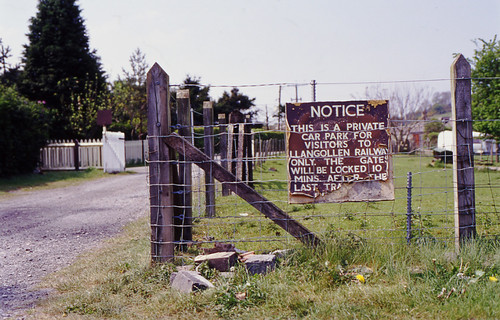
Signs, originally uploaded by John the Monkey.
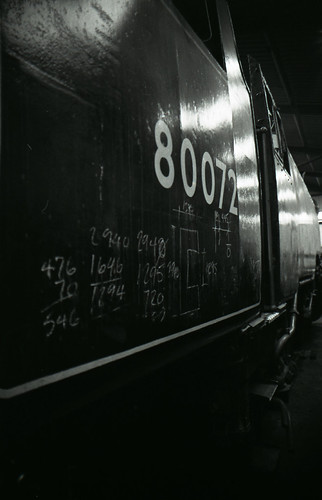
Lastly, I want to share this with you - a detail of 80072, owned by the Llangollen Standard Four Trust. You can read this engine's history here. I'm not sure what the calculations on the side are, but I thought they made for an arresting image.
The volunteers hope that 80072 will be restored and in steam in 2008.
As ever, you can see larger versions of the pictures, and development information by clicking the pictures themselves.
These were taken on the shareholders open day for 5532, (see this post) my thanks once again to the volunteers of the Llangollen Railway Society, and to my Dad for inviting me to the open day.
Tuesday, May 29, 2007
Some Context

The Notice
There is something of a story behind this set of shots, so rather than write it in the descriptions on flickr, I thought I'd offer it here. I have an uneasy relationship with context in photography (which I'll hopefully expand on at some point on these very pages) and won't force you to see the shots with back story if you don't want to.
Some time ago, my Father purchased shares issued by the Llangollen Great Western Railway Group in the resoration of a steam locomotive.

5532
This very locomotive, in fact, No. 5532. It's currently in the process of restoration, and one of the things the Railway Society does from time to time is hold an open day for shareholders to see the progress so far. These are guided by the volunteers carrying out the work. Dad was kind enough to invite me along to this one, and I had the chance to take some pictures as we were shown the engine and workshop.
The workshop itself was tremendously impressive, as was the dedication and hard work put in by the volunteers.
The light was less so, with my meter indicating speeds of between 1/15s and (rarely) 1/125s, this with my Vivitar Series One lens wide open at f/2.8! (I'd chosen to use a zoom because some places in the workshop are dangerous, so the old prime + shoeleather zoom technique would have been inadvisable).
I put my faith in the exposure latitude of HP5+ and shot at a constant 1/125s to try and ensure sharpness. In development, I gave the film a one stop push to 800 in Ilfotec DD-X, hoping it wouldn't affect the stuff shot on meter for 400ISO too badly, and would lift the underexposed shots sufficiently to make them usable. It seems to have worked out pretty well.

The Workshop
In closing, I should thank my Dad for inviting me along, the volunteers at Llangollen for their hard work and perhaps Ilford for HP5+ :)
Larger versions of the shots, and development information can be found by clicking the images.